
Computer Says Die
Bureaucracy in the age of mass social murder

If you put tomfoolery into a computer, nothing comes out of it but tomfoolery. But this tomfoolery, having passed through a very expensive machine, is somehow ennobled and no-one dares criticize it.
Anne Frank died of typhus.
Technically, I mean. We know that Anne Frank was one of millions of victims of the genocide perpetrated by Nazi Germany.
But, technically, she likely died of typhus. One so inclined could leave it at that, and not mention that Anne Frank would’ve contracted typhus, a disease transmitted by fleas and lice, because of the filthy, overcrowded conditions at Bergen-Belsen concentration camp, where she was imprisoned by the Nazis. A survivor who saw her in person there described her as “no more than a skeleton”, freezing in just a blanket, because her clothes were so crawling with lice that she’d discarded them. Further, one so inclined could also leave it at that, and not mention that Anne Frank only came to find herself reduced to a freezing, lice-covered living skeleton in a concentration camp because she was taken there from her (secret) home and separated from her family, by people who wanted her and her family to die, in a gas chamber or otherwise.
Though she wasn’t thrown into a gas chamber, to call her anything but a very much intended victim of the Holocaust would be akin to Holocaust denial, a crime in both her native Germany and in Israel.
The case of Anne Frank comes to mind as news emerges of skin diseases and rat infestations in Gaza, amid a collapsed local medical system, and vital aid, from prosthetic limbs (in a place with the world’s largest concentration of amputee children) to basic essential drugs and even baby food, continues to be illegally blocked.

In July 2024, the medical journal The Lancet used "a conservative estimate of four indirect deaths per one direct death” (another paper in the same publication says estimates can go as high as 15 indirect deaths per direct death in other recent conflicts), to understand the true death toll in Gaza, because the official figure (now at just over 75,000) only includes “violent deaths”, victims of attacks who die in hospital or whose bodies are brought there, and properly identified. The official figure leaves out not just those buried under the rubble or who might die from injuries days or weeks later, but especially those multiples more who might die from starvation, exposure, or lack of medical care.
The attacks on desalination plants and the compounding effects of lack of water - contributing to thirst and poor hygiene as well as difficulties in food preparation - has already been noted by MSF, Human Rights Watch, and the UN as a deliberate tool to accelerate the killing. The potential for epidemics was previously acknowledged and welcomed by an influential retired former IDF Major-General, Giora Eiland.
In 1945, they’d similarly be counted as intended victims of a genocide, but in 2026, politicians and a complicit media ensure that these new living skeletons are people who just happened to be there, casualties not of a multinational machinery of genocide, but of simple rats and germs.
Weaponised bureaucracy and the new face of war
In a previous article, I mentioned the almost comical example of how UK product labelling laws can allow a product that’s 85% apple juice to be labelled as “Strawberry and Blackcurrant organic fruit juice”. But the very same principles of law and bureaucracy can be used to launder truly grotesque injustice.
Israel bans the entry of so-called “dual-use” (civilian and military/offensive) items into Gaza, arguing that they can be used as weapons. The definition of “dual-use” is so broad that it includes even medical products containing a (conveniently) unspecified amount of glycerine, a common cold medicine ingredient, for unfounded fears that enough can be accumulated and made into explosives. Medical equipment and even tent poles are subject to similar restrictions. Many of these practices predate even October 7th, with essential cancer treatment equipment prohibited in Gaza.
Even as essential aid is stopped at the border, commercial goods find their way in. An investigation by Egyptian outlet Mada Masr revealed that commercial goods were being classed for statistical purposes as aid, inflating aid entry figures and thus allowing Israel to officially remain compliant with aid entry requirements.
This weaponised bureaucracy rests on two pillars: on one side, a definition of “restricted”, of what you want to ban, that is so broad that almost anything can be placed in that category, if so desired by the weaponiser, and on the other, a definition of “authorised” that is so specific that it barely even exists, small enough to let nothing through, but just present enough that it provides a fig leaf of reasonableness, while insidiously shifting a heavy burden of compliance onto organisations trying to get aid into Gaza.
Life-saving medical equipment is treated as a dangerous weapon, and hundreds of thousands dead (plus tens of thousands of orphans and amputees, and millions displaced) become just unfortunate collateral damage in a war against Hamas, rather than the very much intended victims of a genocide, if they even get mentioned.
It’s important to note just how calculated1 and deliberate this is, because it also applies clearly on part of the definition of genocide:
In the present Convention, genocide means any of the following acts committed with intent to destroy, in whole or in part, a national, ethnical, racial or religious group, as such:
Killing members of the group;
Causing serious bodily or mental harm to members of the group;
Deliberately inflicting on the group conditions of life calculated to bring about its physical destruction in whole or in part;
Imposing measures intended to prevent births within the group;
Forcibly transferring children of the group to another group.
Through tricks like these, the open violence of bombs and bullets is merely converted into the quiet violence of hunger and stagnant water, made all the more pernicious because now you get all of the death and suffering, but even more muted news coverage. This is then compounded with the presence of a “cease-fire” on paper, but not in practice, which creates the space for continued aggression and daily attacks, leading to Orwellian headlines like “Gaza: Israeli strikes cause near-daily deaths despite ceasefire”, or indeed now also “Cease-Fire Tested by Confusion Over Strait and Strikes on Lebanon” after Israeli aistrikes killed at least 182 people in a single day. Near-daily attacks and mass killing “test”, but apparently do not break, a ceasefire.
Beyond Gaza, weaponised bureaucracy also manifests as lethal economic violence. Another paper in the The Lancet points to sanctions by the US and/or EU killing over 500,000 people each year, between 1971 and 2021, more than five times the number of direct victims of conflict in the same period. One-third of the world is under sanction, and sanctions disproportionately affect the most vulnerable people in those countries, less able to escape to another country or to wield their influence at home to protect themselves.
Maybe our rulers are ignorant, and think sanctions are a scalpel, when they are in many ways as much of an axe as actual kinetic warfare. But this is being too kind to them, for they do this knowingly, as US Treasury Secretary Scott Bessent admitted: the US doubled down on sanctions on Iran specifically to collapse the economy and create political instability.
Bear this in mind if, in a few weeks or months, the US takes over Cuba. There has been a ramping up on sanctions over the past few months, affecting even third countries selling oil to Cuba, threatened with trade tariffs if they do so, with a further escalation just a few days ago. People are already dying. This is economic terrorism.
Terrorism can be broadly understood as a method of coercion that utilizes or threatens to utilize violence in order to spread fear and thereby attain political or ideological goals.
United Nations Office on Drugs and Crime
This cynicism doesn’t begin or end there. Even as our rulers take an axe to entire economies, crippling the livelihoods of countless millions, they also apply toothless sanctions on those in actual power, in order to create the appearance of concern and action.2
It’s just a variation of the weaponised bureaucracy playbook: sanctions so broad, on one hand, that essentially an entire country is affected, and so precisely targeted, on the other, that in practice they’ll never strike anyone or anything meaningful.
Computer says die
If semantic legerdemain can transform bureaucracy into a weapon, it can also transform mouse clicks into trigger-pulls and office workers into murderers.
Nowhere has this been made clearer than in the current generalised assault on Palestine and the wider Middle East. New drone- and AI-powered technological abilities make killing easy. “Relaxed” rules of engagement allow up to 20 civilian deaths as collateral damage for even a low-level “terrorist” target, and virtually any “fighting-age male” can be labelled as a “terrorist”.3
These unprecedented technological capabilities, and the casual labelling of people as terrorists, combine to turn mass murder into a smooth, business-like “workflow”.
From +972 Magazine, describing an Israeli targeting system codenamed Lavender (emphasis mine):
With rapid target generation comes the need for rapid authorization: intelligence officers who spoke to +972 admitted to devoting a mere 20 seconds to sign off on individual strikes, despite knowing that Lavender [Israel’s AI targeting system] misidentifies targets — even by its own lax criteria — in approximately 10 percent of cases. Many took to simply ensuring the person they were about to kill was a man.
“What struck me from the [+972] report is the degree of autonomy and reliability that the armed forces gave this technology,” Alonso Gurmendi Dunkelberg, a lecturer in international relations at King’s College London, told +972. “It allows the army to coldly sign off on the systematic targeting of a civilian population.”
Ben Saul, an international law professor and UN Special Rapporteur on Human Rights and Counterterrorism, said that overreliance on these systems lends the veneer of rationality to the devastation that Israel has wrought in Gaza.
These are life-and-death decisions affecting potentially hundreds of people, made in as little as 20 seconds. For all the information absorbed by the technology, almost none of it is actually factored into the decision-making of the human who is supposedly in charge.4
As an AI specialist commented for the LA Times (emphasis mine):
These systems use data, not logic, to determine if someone is dangerous. And if that information is flawed, then it would keep repeating the same mistakes, but faster and with more confidence.
It creates this illusion of certainty, and that’s dangerous because it turns correlation into action without always having context.
When I said this turns mass murder into a business-like “workflow”, I meant it quite literally. Data integration tech company Palantir Technologies recently hosted the 9th edition of its AIPCon, where Palantir executives and engineers, as well people from the customer side, showcase applications of the Palantir AI Platform.
The “customer side” includes, in this case, the United States’ recently renamed Department of War, whose Chief Digital and Artificial Intelligence Officer, Cameron Stanley, enthusiastically showed off the integrated workflow of remote killing as part of Project Maven, a Manhattan Project of sorts, dedicated to data integration and machine learning in service of accelerated target selection and decision-making on the battlefield:
Through the camera feed from a satellite or drone, a user on a single platform can move from Target Detection (spying on a target), to Course of Action Generation (what to do with that target), where they can Identify the Best Asset to Prosecute (preferred killing method) that target, and swiftly move on to actioning (actually killing) that target, thereby Closing the Killchain, leaving you at your Desired End-state.
The presentation also includes a short history of the development process. A PowerPoint not too different from what you might see at a organisation figuring out how to upgrade its IT, but in this case the organisation is the US Department of War, and the IT’s job is to kill people.
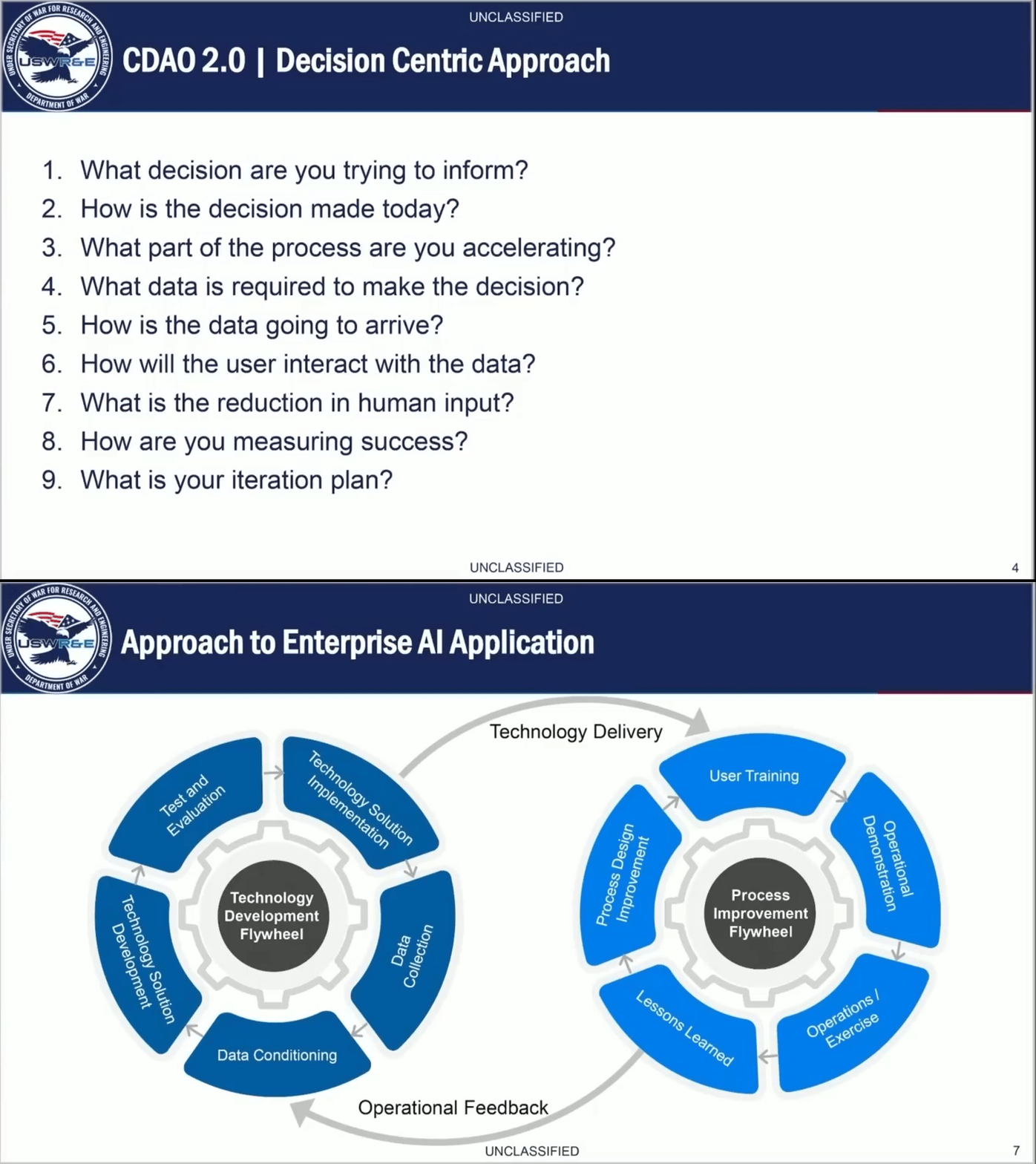
Where drone warfare made bombings look and feel like action videogames, even using videogame controllers, the new target selection and actioning is somewhere between a PowerBI dashboard and a Real-Time Strategy game.

Soldiers on the ground (including IDF genocidaires), and even drone pilots, get PTSD from their actions. Terrible as it is, the trauma or moral injury of taking part in acts of violence can be a powerful disencentive to engaging in war. By transforming lethal violence into “left click, right click, left click” on what looks like a standard spreadsheet or database, are we entering dangerous “banality of evil” territory?
If all this sounds like it’ll make committing war crimes easier, have no fear: Palantir wants war crimes to become legal. Not by changing any laws so as to legalise war crimes (at least openly), but by ensuring that war crimes are only committed after full legal and bureaucratic vetting. Nothing changes on the ground; everything changes in terms of paperwork. From a December 2025 interview with Palantir CEO Alex Karp:
Andrew Ross Sorkin: You talked about the rule of law, and you talked about things being “constitutional”. So talking about these boats that were blown up (…), the question is whether this is being done on a “constitutional” basis and being done in the right way, and if it’s not being done in the right way, how do you feel about that?
Alex Karp: Part of the reason that I like this questioning is, the more “constitutional” you want to make it, the more precise you want to make it, the more you’re gonna need my product. So you keep pushing on making it “constitutional”. You know I’m totally supportive of that. You would need to understand where the things are going, how are they going, under what conditions, where do they belong…
Notably, neither of them pauses to ponder the right or legitimacy of carrying out an extrajudicial execution in international waters in the first place; for the Palantir executive and the journalist questioning him, it’s simply a matter of operational ability and legal cover.
As we’ve seen already, it can be shockingly easy to hide injustice behind laws and rules. Between weaponised bureaucracy and general American/Western impunity on the world stage, it becomes a trivial matter to label this person a terrorist or that person a drug trafficker, and then murder them in international waters.
It’s like a Swiss cheese. Crimes go into a hole on one end, and if they successfully navigate their way through the cheese’s tunnels of bureaucracy and flexibly applied legal requirements, they can come out of a hole on the other end as fully-vetted, Constitutionally-sanctioned military interventions. Karp believes that Palantir, through its integration of multiple systems and sources of data, encompassing intelligence that unfolds into dozens of types and from countless sources, with layers of approvals and supposed oversight (see the Lavender example above), is uniquely positioned to navigate this process.
Swiss authorities have kept Palantir out of government contracting, for fears of data exposure to prying American eyes, and because its systems entail continued dependence on foreign and third-party expertise. In the UK, on the other hand, the company has already won significant contracts with both the Ministry of Defence and the NHS.
There are initiatives to stop and reverse this integration in the UK, from civil society groups like the Good Law Project to proposals from the Green Party, but for now the British government is unmoved.
Crushed under the flywheel
The Palantir presentation showed a “Process Improvement Flywheel” and a “Technology Improvement Flywheel”.
The “flywheel” concept was popularised by Amazon, as a representation of the interlocking parts of its sprawling business empire, and how they accelerate each other. It was outlined by Brad Stone in “The Everything Store” (2013), describing Amazon’s business model at the time, before its Tetsuo-like explosion into an all-encompassing writhing mass of retail, advertising, logistics, media, web services, and more.
Drawing on Collins’s concept of a flywheel, or self-reinforcing loop, Bezos and his lieutenants sketched their own virtuous cycle, which they believed powered their business. It went something like this: Lower prices led to more customer visits. More customers increased the volume of sales and attracted more commission-paying thirdparty sellers to the site. That allowed Amazon to get more out of fixed costs like the fulfillment centers and the servers needed to run the website. This greater efficiency then enabled it to lower prices further. Feed any part of this flywheel, they reasoned, and it should accelerate the loop.
From “The Everything Store”, by Brad Stone (page 98)

The two Palantir “flywheels” feed into a third, larger flywheel: Palantir integration into government generates profits, which allow the company to improve its ability to integrate into other government functions but also to lobby governments and accelerate its revolving door as it hires more former high-level politicians and civil servants, allowing it to win even more contracts.
This third flywheel should be seen as a more of a vicious cycle: governments like the UK lose key staff to Palantir, whose tools become increasingly ingrained in more and more government functions, essentially giving the US both a spyglass into and a killswitch against the highest levels of the British State, should it ever fall out of compliance.
Palantir works with ICE, and its founders and executives hold deranged views (untaxed freedom for me, police-state for thee) and have provided massive political funding for American Vice-President JD Vance himself.
This deepening, incestuous relationship between state and corporation is far from the only one. Other tech giants are also getting in on the act, including Amazon (where Cameron Stanley worked at one point, specifically on Defense projects), Google (the original tech partner for Project Maven, which at the time resulted in a worker rebellion - evidently no such compunctions with war crimes exist now), SpaceX (already a major government contractor), and Nvidia, among others, now reliant on government revenues as well as goodwill to prop up what are likely massively overvalued share prices, or in the case of SpaceX to ensure the success of its planned titanic IPO.

That relationship cuts both ways: companies might profit off the State, but they also become subject to its demands. When Anthropic insisted that its AI systems not be used in “mass surveillance of Americans or in fully autonomous weapons”, OpenAI rushed to fill in that spot, while Anthropic got classified as a “supply chain risk”, a label that had hitherto only been applied to companies from countries like China. While what that means for Anthropic is disputed, it shows that the State is willing to use bureaucratic tools to bully domestic companies like it does to bully foreign companies or even other States.5
Globally integrated tech and banking systems, exposed to the whims of an increasingly belligerent and totalitarian US, have also meant that US sanctions can now essentially digitally and financially unperson even the ICC prosecutor, a European ICC judge, or a UN Special Rapporteur, while European “leaders” do nothing. There are fears that this could also be applied to the critical data and tech services that other Western governments increasingly outsource to the US tech giants, to ensure compliance with American sanctions, assistance in American war crimes, or submission to its trade demands.
Closer to home
The bureaucratic and institutional laundering of violence and injustice does not begin or end in Gaza.
On the morning of December 4th 2024, in New York City, UnitedHealthcare CEO Brian Thompson was shot dead by an assailant, suspected by authorities to be Luigi Mangione, a then 26 year-old former tech worker.

The spent cartridges had words written on them: “delay”, “deny”, and “depose”, a suspected call-back to the tactics used by American health insurers to avoid paying out claims. UnitedHealthcare carried some of the highest claims rejection rates in the industry, and a 2009 study suggests some 45,000 people in the US die every year from lack of access to healthcare.
The physical violence against Thompson, for which Mangione has been arrested and is facing a possible life sentence, contrasts with Thompson and UnitedHealthcare’s economic violence against their patients customers, for which they were rewarded with over $10 million per year and about $15 billion in annual profits, respectively.
Going back to the one of the forms of genocide, the “deliberately inflicting conditions of life calculated to bring about the physical destruction of a people”, there’s a clear connection to the concept of “social murder”, popularised by Friedrich Engels in 1845 (emphasis mine):
When one individual inflicts bodily injury upon another such that death results, we call the deed manslaughter; when the assailant knew in advance that the injury would be fatal, we call his deed murder. But when society places hundreds of proletarians in such a position that they inevitably meet a too early and an unnatural death, one which is quite as much a death by violence as that by the sword or bullet; when it deprives thousands of the necessaries of life, places them under conditions in which they cannot live, (…) and yet permits these conditions to remain, its deed is murder just as surely as the deed of the single individual; disguised, malicious murder, (…) because no man sees the murderer, because the death of the victim seems a natural one, since the offence is more one of omission than of commission. But murder it remains.
I have now to prove that society in England daily and hourly commits (…) social murder, that it has placed the workers under conditions in which they can neither retain health nor live long; that it undermines the vital force of these workers gradually, little by little, and so hurries them to the grave before their time.
Through a cocktail of lobbying dollars, legal loopholes, and kafkaesque bureaucracy, executives at US healthcare providers continue to engage in mass (social) murder that would make a serial killer blush, without firing a single bullet or incurring a single day in prison. Indeed, if you thought the 20-second Lavender killing decisions were fast, doctors at rival medical insurer Cigna spent 1.2 seconds per denied claim. How’s that for efficiency?6
Government policies can also result in mass social murder right at home: studies suggest that over 330,000 “excess deaths” in the UK were linked to the austerity policies implemented between 2012 and 2019.
Procedure has proven a favourite hiding place for the British political estabishment’s malfeasance. British politicians point to “robust and proper guidance and procedures” when questioned about the mistreatment of political prisoners on hunger strike or the continued arming of Israel’s genocide in Palestine, and invoke procedure to explain the appointment of close Epstein associate and long-known sleazemonger Peter “Prince of Darkness” Mandelson as British Ambassador to the US.
A compliant media then helps to bury everything by turning obvious sleaze and corruption into coma-inducing slow-burn bureaucratic drama.7
British authorities have also weaponised the legal classification of “terrorist”, not to kill, but to legally persecute direct action groups like Palestine Action, and to suppress free speech by making even a peaceful show of support for them an arrestable offense. One activist is on trial now for alleged support for Hamas (not by fighting, recruiting, or even funding - just via social media posts), facing up to 14 years in prison. Meanwhile, thousands of Brits who actively join the genocidal IDF face no such persecution.
Murderous abstraction
Human beings are disassembled, broken down into metadata and data points - phone location signals, app usage, social media posts, being a “military age male” - and marked for death by an AI algorithm. The excrutiating martyrdom of a child in a concentration camp, from Bergen-Belsen to Gaza, is made into just a statistic among other collateral deaths. Entire lives are reduced to figures on spreadsheets and databases.
The denial of medical care is marked as simply a “negative customer experience”, to be weighed against potential savings that can be proudly presented to shareholders. Deaths from austerity don’t get a line in government budgets.
Western governments aren’t aiding and abetting war crimes by arming a genocidal state - they are simply following procedure, by authorising weapons exports to countries that are not on any embargo list. They are not suppressing free speech, but merely cracking down on support for terrorism (as they define it).
These are the layers of abstraction that turn human beings into datapoints, datapoints into small decisions, small decisions into mass killing, mass killing into collateral damage, and collateral damage into shareholder value and legally-sound politics.
“The world’s biggest criminals and tyrants have learned the languages of democracy, dignity and rights”, writes anthropologist Arjun Appadurai. From Gaza to Silicon Valley, are we witnessing “a vast worldwide Malthusian correction, (…) geared to preparing the world for the winners of globalization, minus the inconvenient noise of its losers”?8
Bombs and bullets, rats and lice, sanctions and prohibitions, laws and lines of code: we’re trapped in a maze, and many of us aren’t meant to make it out.
See also Alex de Waal of Tufts University, who said “I’ve been working on this field of famine, food crisis and humanitarian action for more than 40 years, and there is no case, over those four decades, of such minutely engineered, closely monitored, precisely designed mass starvation of a population as is happening in Gaza today.”
Another glaring example of the UK’s cynicism regarding both Israel and the UK’s status as a safe haven for ill-gotten gains. This is meant to curb illegal settlement expansion, but not only does the UK continue to allow imports from illegal Israeli settlements in Palestine (it does not, for example, allow imports from Russian-occupied Crimea), they even allow UK registered charities to help Brits move to those settlements.
UK sanctions are applied on individual ministers, but what difference does it make to an extremist Israeli minister, without assets held in the UK and who rarely travels outside Israel, if they are subject to asset seizure or a travel ban?
This is also made doubly apparent when you consider just how many foreign despots and their cronies, from the former Soviet bloc to West Africa to even Iran, allegedly hold immense assets in the UK and other Western bloc countries. See also the genocidal UAE’s investment in Manchester City or the brutal Saudi regime’s investment in Newcastle; they get to keep their investments, while Russian oligarchs are forced out. They’re only “criminals” if the UK happens to dislike them at that moment, otherwise it’s fair game.
The Russian example proves that if the UK were actually interested in stopping any of this, they would.
Between Israel’s use of separate military tribunals for Palestinians and their 96% conviction rate, trusting their assessment is about as reasonable as asking a Nazi court about a random German Jew.
Technology writer Cory Doctorow has popularised the term “reverse centaur” to discuss human workers whose agency is mostly removed, outsourced instead to a black box AI that does the thinking for them, so rather than being empowered by AI to do more, they are instead serving merely as physical apendages or legal accountability patsies for the jobs that an AI or robot cannot do (yet).
While the typical example is an Amazon worker, whose delivery van route or path through the Fulfilment Centre are set for them, and all they do is put things in boxes, or drop those boxes at the door, there is a also a “knowledge worker” version of the Reverse Centaur: one who serves as a human to blame when the AI screws up, or merely as a fig leaf of human intervention, because the thought that machines are making and carrying out life-or-death decisions on humans is too terrifyingly Terminator-esque (for now).
Anthropic doesn’t have a principled opposition to American violation of international law, to be clear: its software was used in the Venezuela raid where the US kidnapped President Nicolás Maduro, and they previously had a partnership with Palantir specifically for US military and intelligence operations.
I’m not suggesting that healthcare executives actively wish to kill anyone, but rather, that they are financially rewarded for making decisions that can, effectively, result in the deaths of thousands.
The video below has a slightly sensationalist title, but the journalist brings copious receipts that show just how badly the British public has been lied to by its own media in the Labour/Mandelson/Epstein affair.
I highly recommend reading his full essay. It’s fantastic, and indeed inspired part of what I wrote here.
It’s also much shorter than this diatribe. If you made it this far: thank you!
this is portentous