
The fine print revolution
Twisting the arc of the moral universe

There must be in-groups whom the law protects but does not bind, alongside out-groups whom the law binds but does not protect.
This Monday, January 19th, marked the 40th Martin Luther King Jr. day.
King is remembered as a pacifist who campaigned for racial equality. The decades since his murder have helped to erode away the thornier parts, sanding and smoothing his radicalism into harmless activism, and effacing the American government and wider public’s disapproval and even hatred of him, so that a history of struggle, police brutality, and imprisonment; of a government and society that at every turn resisted the change we now cherish; of a painful battle for rights that are now taken for granted, is polished into a story about a man who spoke up assertively but politely, a system that heard him, and a change that was achieved.
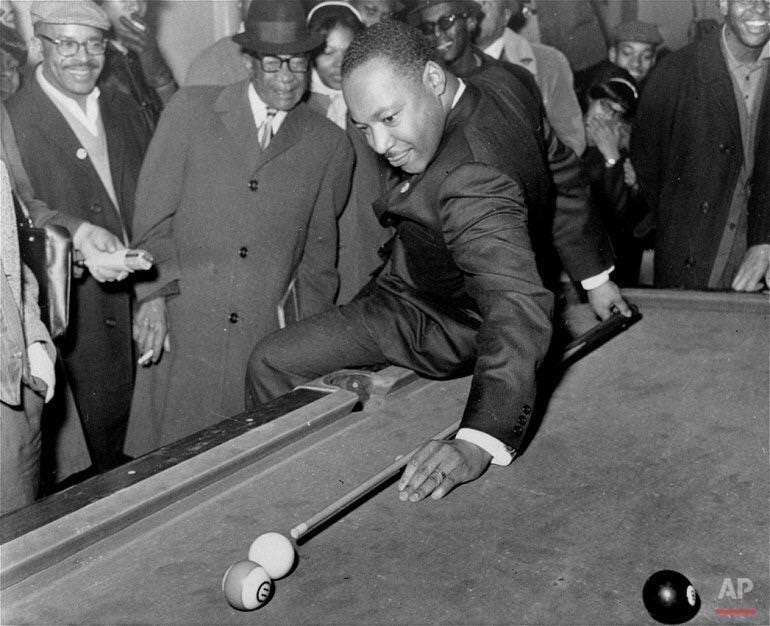
The civil rights leader was no liberal, but rather an unabashed radical. A self-professed democratic socialist (the same label claimed today by Bernie Sanders and Zohran Mamdani), with sharp views not just on racism in America but also American imperialism, the Vietnam war, and the economic system governing people of every race, King called for “a radical redistribution of economic and political power”, and understood that these various causes were connected, so that “you can’t really get rid of one without getting rid of the others”.
In his “Letter from a Birmingham Jail”, he denounced the “white moderate”, going as far as arguing that with their passive obstruction of progress, they were possibly a greater obstacle to liberation than even the full-blown racists in the KKK (emphasis mine):
I have almost reached the regrettable conclusion that the Negro's great stumbling block in his stride toward freedom is not the White Citizen's Counciler or the Ku Klux Klanner, but the white moderate, who is more devoted to "order" than to justice; who prefers a negative peace which is the absence of tension to a positive peace which is the presence of justice; who constantly says: "I agree with you in the goal you seek, but I cannot agree with your methods of direct action"; who paternalistically believes he can set the timetable for another man's freedom; who lives by a mythical concept of time and who constantly advises the Negro to wait for a "more convenient season."
This could’ve been written today. Climate activists blocking a road are considered a bigger inconvenience than a flood completely destroying it. Liberals say that they sympathise with this or that cause, but insist that any struggle towards its realisation take place through “the appropriate channels”, or that “now is not the time” to demand better from our leaders, because it’s a tight election and a political candidate has to compromise to win (that a candidate is in a tight rather than easy election because they are compromising never occurs to a “moderate”). Or, in short:

That “the appropriate channels” just happen to be controlled by people who want one’s cause to fail, or that politicians combining a popular mandate with political power, from Donald Trump to Zohran Mamdani, can and do make transformational changes in a short period, is conveniently disregarded. These are the same people who would’ve told Rosa Parks that they sympathise with her plight, but the bus needs to get moving and could she please just sit in the back.

In an early example of how “one day, everyone will always have been against this”, while MLK is today revered as a civil rights icon, he was widely despised when his actual struggle was taking place. Even after he won the Nobel Peace Prize in 1964, Americans overwhelmingly viewed him unfavourably. The broader civil rights movement was similarly derided.
The fine print revolution
It’s hard not to think of MLK and his victorious but tragically incomplete struggle, when I hear the world screaming for change, only to be met with silence, derision, a fraction of what is actually needed or, as seems to be more and more the case, to simply be pissed on but told that it’s raining.
In a Western liberal democracy, revolutions still do occur, but now they take decades to play out, in boardrooms and courts rather than the streets, and with arcane legal disputes rather than rousing speeches and million-man marches. That you often need professional training just to grasp what is going on is not a coincidence - you and I likely lack the tools, while an oligarch can hire a whole army of experts to fight protracted legal battles in their name.
Cory Doctorow has written about “MEGO” (“My Eyes Glaze Over”), a method for scamming people under the cover of mind-numbingly dense legalese. Much like how someone wearing a hi-vis can commit massive crimes in broad daylight, strategic use of MEGO allows truly extraordinary perversions of justice to go undiscovered or even to be legitimised.
Victims can include everyone from a severe food allergy sufferer, killed by corporate negligence at a Disney resort, whose husband was initially blocked from pursuing justice in court because of an obscure clause in a free Disney+ 1-month trial1, to supposedly sophisticated investors getting hoodwinked on a technicality by their counterparty in a complex derivatives trade.2

This “fine print revolution” has three main consequences. First, it takes battles that should be taking place in the streets, in full view of the world, and hides them in court rooms, where they take place mostly unseen and unheard by the public, but are no less consequential. Second, it muddies the waters between what is good and what is legal, and what is bad and what is illegal, so that an obvious scam can be made legal and therefore legitimate, and an obviously fair demand can be rendered void by some cleverly-worded contractual footnote. Finally, it centres the debate around seemingly niche legal questions, taking the focus away from discussing or fighting for the actual cause.
A good example of these three consequences is the “debate”, if we can still call it that, around Israel’s genocide in Gaza. While there was a back and forth about whether or not the horror inflicted on Gaza constituted a genocide, Israel kept mass murdering Palestinians, and Western governments kept arming the murderers. Not only was the “genocide question” a distraction from the fact of plainly unjustifiable mass murder, even now that everyone and their mother has declared it a genocide, the killing continues unabated.
I admit I’m one of those people who write to their MP. I’ve repeatedly written to mine, asking why the UK keeps exporting weapons to Israel, which is committing a genocide, making the country complicit in the crime of all crimes. His answer is always some form of “it’s legal”3, and that the UK government has not determined that there is in fact a genocide. The fact that it’s legal excuses my MP from having to grapple with the moral matter of whether it’s appropriate for his country to sell weapons to a country currently engaged in the Holocaust of our time.
Finally, this emphasis on legal determinations means that the hundreds of thousands campaigning every month for over two years - the largest, most sustained protest movement in the UK since at least the 2003 Iraq invasion - count for nothing, with the real fight taking place in courts where the government has ample leeway to stack the deck in their favour. This is also how you get Bill Clinton arguing about “what the meaning of ‘is’ is”.
Corporations, oligarchs, and authoritarians are more than wise to the potential of the fine print revolution. For example, in 2013, instead of trying to directly ban abortion, which would inevitably be met with controversy, Texan lawmakers used Texas House Bill 2 to legislate on things like safety standards and even the width of corridors at abortion clinics, tightening these superficially unrelated rules so that abortion would effectively all but be banned in the state. Similarly, burqa bans skirt anti-descrimination laws by being framed as a public safety measure, even when legislators are open about doing it for islamophobia. These abuses can take all forms, like labelling laws that allow a product that’s 85% apple juice to be labelled as “Strawberry and Blackcurrant”, or custom-written legislation exempting political donors’ companies from minimum wage laws on account of weird, ultra-specific carve-outs.
There’s also an almost Borgesian element to this when, to suit their needs, rulers pass new laws to try and remake reality out of whole legal cloth. When British courts ruled that the Conservative government’s scheme to resettle refugees in Rwanda meant sending people to an unsafe country, the government responded by passing a law simply declaring that it is a safe country. Faced with a 6-month waiting list for driving exams, the current Labour government is mulling a new law mandating a 6-month waiting period, turning an undesirable backlog for the government into merely a legally required waiting period for student drivers. As legal challenges bore down on Donald Trump, judges that he himself appointed produced a ruling giving him significant immunity from criminal prosection.
Corporations do it too. When a teenager killed himself with advice from ChatGPT (suggesting that he hide his noose so his family wouldn’t find it, and that he “could disappear and no one would even blink”), OpenAI washed their hands of it by arguing that using ChatGPT to commit suicide was a violation of its terms of service.
A paper shield
As abuse after abuse is waged against normal people under the cover of legality, one wonders if the same system of laws that spares us from that other law (of the jungle) has become corrupted to the point that all that’s left is an impregnable legal fortress for the ruling elites, and a soggy paper shield for the rest of us.4
It’s worth at least questioning the legitimacy of such a legal and political system, where laws are a matter of convenience rather than principle. Can our collective human flourishing ever come from an edifice built on such cynical foundations? Because ultimately all this - law, government, civil society, even the very idea of countries - is just a fiction we collectively believe in. But suspension of disbelief can only go so far.
International law, as recently recognised by Canadian Prime Minister Mark Carney at Davos, has all but been exposed as just a convenient fiction.5 In the US, the second Trump administration is essentially throwing the Constitution in the bin and daring the rest of the country to stop him. In the UK, the government walks a thinner and thinner line as it tries to continue arming a genocide, applying an increasingly ridiculous double standard between Russia and Israel, while staying on the right side of the law (it is likely that they’ve also failed at that).
Part of me wonders if elites’ impregnable legal fortress will turn into another soggy paper shield, just like ours, and if our rulers will find that it protects them about as much as the divine right of kings protected Louis XVI. Another part wonders if a population disenchanted with civic engagement, too focused on just trying to survive day-to-day, or distracted with entertainment (sometimes even produced by the politicians themselves), will simply let this keep happening, in a vicious cycle where acceptance of a perpetually degrading status quo only invites even more oppression.
In either case, we would do well to remember the true story of Martin Luther King Jr. The arc of the moral universe won’t bend towards justice by itself.
Disney later reversed their position following massive public outcry.
I highly recommend reading the full story on Bloomberg, to gain an appreciation of the level of absolute, shameless fuckery involved in high finance. This is what our society is dedicating the most productive years of its supposedly best and brightest to accomplish.
Bloomberg’s Matt Levine has a Michael Lewis-like talent for bringing to life stories about contracts and niche financial instruments, and to make them understandable even for the uninitiated.
To me, “It’s legal” is a defense on the same level as “I was just doing my job”, which famously did not fly at the Nuremberg trials. If anything it’s worse: one is a defense used by soldiers in an aggressively hierarchical system, the other is used other by legislators and policymakers whose very job is to reflect carefully on the morality and significance of a law and to apply it fairly.
This is symptomatic of a wider malaise, wherein our rulers are never asked to explain their reasoning beyond a few slogans (“Stop the boats”, “Israel has the right to defend itself”, “Brexit means Brexit”, etc.), which is how we get unthinking zombies in power, for whom “It’s legal” is where their engagement with a deep, complex issue begins and ends.
Much was said about this unusual candor, but less was questioned about Canada and other Global North countries benefiting from and indeed perpetuating a system that they know to be unfair and even violent.
The leaked texts from French President Emmanuel Macron to Donald Trump show that when it comes to beating up brown people, they’re all still friends. It’s only when the same imperial and colonialist gaze is turned on the American Empire’s vassal states, Canada and Europe, as with the Greenland situation, that they are suddenly so revulsed.
To me, the most important takeaway wasn’t what Carney said, because it’s nothing new to anyone paying attention, or even that he said it. What was revealing to me was the global shock at hearing a politician simply say a (partial) truth.
The shock at this basic fact of geopolitical life being stated out loud at Davos reads as a tacit admission that leaders charged, not always democratically, with making literal life-and-death decisions on behalf of billions of people, spend most of their time engaged in kayfabe. The actually shocking part is that we find this dishonesty normal, even laundering it as “diplomacy” or “statecraft”, and are stunned when a fraction of the truth peeks at us from behind a wall of lies.
Instead of being impressed that one politician said a (partial) truth, the media should be angry that the rest of them keep lying. Instead of being surprised that a politician recognised an injustice against his country or its allies, they should be apalled that that same politician knowingly committed, and indeed will continue to commit, even worse injustices against other countries.